
Florida summer festivals, concerts, parades, sporting events, and waterfront celebrations often place large numbers of pedestrians close to moving vehicles. Temporary traffic routes, crowded parking areas, rideshare activity, sudden rain, intense heat, alcohol use, and limited nighttime visibility can increase the risk of a serious pedestrian collision.
After a pedestrian accident, getting medical care, reporting the crash, photographing the area, and preserving witness information can protect your health and your legal options. Serrano Law helps injured pedestrians in Hillsborough County and nearby Florida communities understand how evidence, insurance coverage, medical documentation, and fault may affect a personal injury claim.
Festival grounds may be temporary, but the injuries and financial losses from a pedestrian crash can last much longer. Evidence should be preserved as soon as possible.


Why Summer Events Change Normal Traffic Patterns 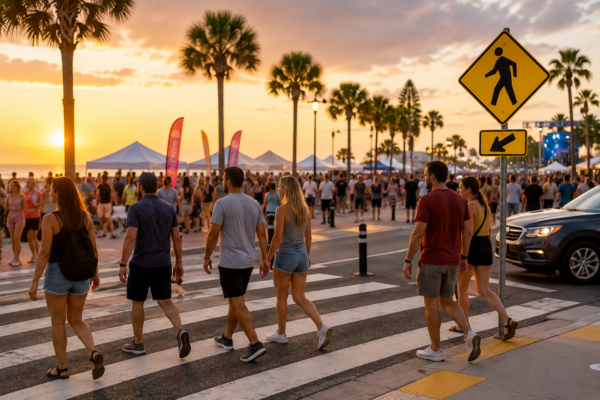
A road that usually carries routine local traffic may operate differently during a festival or community event. Streets may close, lanes may shift, and drivers may be directed toward temporary parking areas that they have never used.
Pedestrians may also need to follow unfamiliar walking routes. Barriers, food vendors, stages, crowds, and security checkpoints can block normal sidewalks or crossings. Visitors may park several blocks away and walk through residential roads, shopping areas, hotel entrances, or commercial driveways.
These changes create more places where vehicles and pedestrians cross paths. A driver may turn suddenly after missing an entrance. A pedestrian may step around a parked vehicle without seeing traffic in the next lane. A rideshare driver may stop in an active travel lane while searching for a passenger.
Many festival-related pedestrian accidents happen outside the official event grounds. Parking lots, side streets, gas stations, restaurants, transit stops, and rideshare pickup areas may become especially congested before and after an event.
Founding Attorney Attorney Attorney
Michael Serrano
Candace “Cea” Hartley
Molli Gard, ESQ.
Crowds Can Make Individual Pedestrians Harder to See
Drivers may notice a crowd without seeing every person within it. Children, older adults, wheelchair users, and people walking behind taller pedestrians can be difficult to detect.
Parked trucks, buses, vendor tents, temporary signs, landscaping, and rideshare vehicles may also block a driver’s view. A pedestrian may believe that a driver can see the entire group when only part of the crossing is visible.
Crowds can influence pedestrian behavior. People may follow others into a roadway without checking traffic for themselves. Families may become separated. A person may suddenly stop, turn, or step backward while looking for another member of the group.
Common visibility hazards near Florida events include:
- Pedestrians entering the road between parked vehicles
- Children changing direction without warning
- Drivers focusing on parking spaces instead of crosswalks
- Event signs, buses, or tents blocking sightlines
- Passengers exiting vehicles on the traffic side
- Large groups crossing after a concert or fireworks display ends
Drivers approaching crowded areas should reduce speed and prepare for unexpected movement. A busy event does not excuse speeding, distracted driving, an unsafe turn, or a failure to yield when Florida law requires it.
Visitors May Be Unfamiliar With Local Roads
Florida events often attract visitors from outside Hillsborough County and outside the state. These drivers may not know local speed limits, intersection layouts, parking entrances, or pedestrian-heavy routes.
Navigation applications may direct motorists through unfamiliar neighborhoods or toward entrances that have temporarily closed. Drivers may slow abruptly, change lanes late, make sudden turns, or focus on a phone instead of the roadway.
Pedestrians may face similar problems. A walking application may direct someone along a road with limited sidewalks or toward a crossing that is farther away than expected. Visitors may choose the shortest route without understanding local traffic patterns.
A driver’s unfamiliarity with an area does not remove the duty to watch for pedestrians. Drivers should reduce speed, obey temporary signs, follow traffic-control personnel, and avoid handling a phone while the vehicle is moving.
Mike Serrano’s law office was everything I needed after a very traumatic accident. He was always super up front and honest with me. I never got the feeling he was trying to sell me on something or to do something that I wasn’t comfortable with. He listened to my concerns and when it tough moments came that I needed to stand my ground. He backed me and made me feel 100% secure. He got me exactly what I needed in a settlement and I would never consider using anyone else. His office staff is also phenomenal.” - Mary Mike Serrano was a great attorney for my case!! He was very flexible with phone calls/ Zoom meetings. His staff are always friendly, whether it be on the phone or emails. They keep you updated during your entire case! They don’t leave you silent for months. if you call, they always call back with updates! Highly recommend!" - Kylie Collier Border I’ve never had to deal with a lawyer before but Mike has set the bar HIGH. He was always available to communicate my concerns and explain each step of the way. I know no other lawyer would have been able to achieve the same results because he jumped on an opportunity that was a little out of the ordinary and it paid off. He really fought for my case and over delivered. I really hope I never have another accident but if I do I’m running to Mike for help." - Sandy Carter
Parking Lots and Rideshare Zones Create Added Risks
Temporary parking and passenger pickup areas can become confusing during a major event. Drivers may circle several times while searching for a space. Vehicles may back out of tight spaces while pedestrians move behind them.
Rideshare and delivery drivers may stop suddenly near an entrance. Passengers may cross several lanes to reach a waiting vehicle. Drivers may look at an application while moving through a crowded pickup zone.
Depending on each party’s duties, control over the area, conduct, and connection to the crash, an investigation may examine the actions of:
- The vehicle driver
- A rideshare or delivery driver
- A commercial vehicle operator
- A parking contractor
- An event organizer
- A property owner
- A traffic-control company
- A vendor whose equipment blocked visibility
The existence of a contract or a connection to the event does not automatically make a party responsible. Liability depends on the facts, the party’s legal duties, and whether the party’s conduct contributed to the collision.
A pedestrian or cyclist struck by a rideshare vehicle can review related information at https://mikeserranolaw.com/2023/12/14/what-if-i-was-a-pedestrian-or-cyclist-injured-by-a-rideshare-vehicle-in-lutz-florida/.
Heat, Sun Glare, and Sudden Rain Can Affect Safety
West Central Florida’s thunderstorm season generally occurs during the late spring and summer months. Weather can change quickly near outdoor events.
Bright afternoon sunlight may create glare that makes a pedestrian, traffic signal, or crosswalk harder to see. A driver who cannot see clearly should reduce speed and adjust to the conditions.
Heat can affect attention and judgment. People who have spent several hours outside may feel tired, dehydrated, dizzy, or focused on reaching shade, water, or transportation. Families leaving an event may be carrying chairs, bags, coolers, or tired children.
A sudden rainstorm may cause large groups to leave at the same time. Pedestrians may rush toward parking areas, use umbrellas that reduce peripheral vision, or cross at the nearest available location. Drivers may face wet roads, reduced visibility, and heavy congestion.
Weather alone does not decide fault. It may help show why a driver, property operator, or event-related party should have taken added precautions.
Choosing The Right Personal Injury Attorney Personal Injury Settlement TimelineRelated Videos
Evening Events Bring Darkness and Fatigue
Many Florida festivals begin during daylight and end after sunset. Pedestrians who were visible when they arrived may be harder to see when they return to their vehicles.
Florida pedestrian crashes often occur during evening hours. Lighting may be limited in overflow lots, side streets, or temporary walkways. Rain on a windshield, headlight glare, dark clothing, and crowded intersections can further reduce visibility.
Fatigue may affect drivers and pedestrians after several hours of heat, noise, walking, and standing. A tired driver may react more slowly. A tired pedestrian may misjudge a vehicle’s speed or distance.
Event planners, parking operators, and property owners may need to consider lighting, marked walking routes, trained attendants, designated pickup zones, and separation between vehicles and pedestrians. Whether a party had responsibility for any condition depends on control of the property, contractual duties, and the event arrangements.
Alcohol and Distraction Can Increase Accident Risks
Some Florida festivals and sporting events serve alcohol. Restaurants, bars, tailgates, and private gatherings may also be located near the venue.
An impaired driver may have slower reactions, reduced awareness, and poor judgment. An impaired pedestrian may misjudge traffic speed or enter a roadway unexpectedly.
Phones create another source of distraction. Drivers may use maps, respond to rideshare requests, send messages, or search for parking. Pedestrians may look at tickets, event schedules, photographs, or directions while walking.
Alcohol use or phone use by a pedestrian does not automatically prevent compensation. The full circumstances must be reviewed, including vehicle speed, driver attention, crossing location, lighting, traffic signals, witness accounts, and available video.
How Florida Comparative Fault Can Affect a Claim
Florida uses a modified comparative fault rule in many negligence cases. Compensation may be reduced according to the injured person’s percentage of responsibility. A person found more than 50 percent responsible for the person’s own harm generally cannot recover damages in a negligence action covered by the statute.
An insurance company may argue that a pedestrian crossed outside a marked crosswalk, entered traffic unexpectedly, ignored a signal, or was distracted. The pedestrian may have evidence that the driver was speeding, looking at a phone, making an unsafe turn, ignoring temporary traffic controls, or failing to use reasonable caution near a crowded event.
Fault should not be decided from one isolated fact. Photographs, surveillance recordings, vehicle data, witness statements, police reports, event plans, and electronic records may provide a clearer account.
The current Florida comparative fault statute is available at https://www.leg.state.fl.us/statutes/index.cfm?App_mode=Display_Statute&URL=0700-0799%2F0768%2FSections%2F0768.81.html.
Evidence Can Disappear Quickly After a Festival Accident
Festival scenes are temporary. Barricades may be removed overnight. Vendors may leave the area. Vehicles may be moved, and temporary signs may disappear.
Surveillance footage may also be deleted or overwritten. Businesses, parking operators, hotels, city cameras, event organizers, buses, and nearby homes may have recorded the accident or the surrounding conditions.
Useful evidence may include:
- Photographs of the road, crosswalk, lighting, and vehicles
- Videos showing crowd and traffic conditions
- Witness names and contact information
- Police and incident reports
- Event tickets, wristbands, or parking receipts
- Rideshare trip records
- Medical records and bills
- Damaged clothing or personal property
- Weather and lighting information
- Temporary traffic-control plans
- Contracts identifying who controlled parking, security, or traffic
A prompt preservation request may help prevent relevant footage or records from being destroyed.
What to Do After a Pedestrian Accident
Your health should come first. Call 911 when possible and seek medical evaluation, especially if you experience pain, dizziness, confusion, weakness, bleeding, numbness, or difficulty walking.
Symptoms of head injuries, internal injuries, fractures, and soft-tissue injuries may appear or become more noticeable after the initial shock fades.
When you can act safely:
- Obtain the driver’s name, insurance details, and vehicle information.
- Photograph the accident scene and surrounding traffic controls.
- Ask witnesses for their contact information.
- Report the accident to law enforcement and event personnel.
- Save receipts, tickets, messages, and transportation records.
- Follow medical instructions and attend recommended appointments.
- Avoid discussing the claim publicly on social media.
- Do not sign a settlement release before understanding your injuries and legal options.
The Florida pedestrian accident guide provides more information at https://mikeserranolaw.com/2020/10/02/florida-pedestrian-accident-guide/.
A broader explanation of Florida personal injury claims is available at https://mikeserranolaw.com/2020/10/02/florida-personal-injury-guide/.
How Long Do You Have to File a Florida Pedestrian Accident Lawsuit?
Florida generally provides two years to file an action founded on negligence. Other deadlines may apply based on when the accident occurred, the identity of the responsible party, and the type of claim.
A claim involving a city, county, state agency, or another government entity may involve separate notice rules and procedures. A shorter insurance deadline may also affect a particular benefit or policy.
Waiting can weaken a claim even when the filing deadline has not expired. Video may be overwritten, temporary signs may disappear, witnesses may become difficult to locate, and event records may be discarded.
The current Florida limitations statute is available at https://www.leg.state.fl.us/STATUTES/index.cfm?App_mode=Display_Statute&URL=0000-0099%2F0095%2FSections%2F0095.11.html.
How an Attorney Can Help
A festival-related pedestrian claim may require an investigation beyond the driver’s actions. An attorney may need to determine who controlled the parking area, installed the barriers, planned pedestrian routes, managed traffic, hired security, or carried applicable insurance.
Legal counsel can help:
- Request surveillance footage and electronic records
- Contact witnesses
- Review police and incident reports
- Identify potentially responsible parties
- Examine insurance coverage
- Document medical expenses and lost income
- Respond to allegations of pedestrian fault
- Evaluate future treatment and financial losses
- Handle communications with insurers
- File a lawsuit when litigation becomes necessary
Information about starting a Florida injury claim is available at https://mikeserranolaw.com/2022/05/30/what-to-do-when-filing-a-personal-injury-claim/.
Speak With Serrano Law About a Florida Pedestrian Accident
A pedestrian accident near a festival or summer event can leave you facing medical treatment, missed work, insurance calls, and uncertainty about who was responsible.
Serrano Law offers free consultations and helps injured people in Hillsborough County, Lutz, Tampa, Wesley Chapel, and nearby Florida communities understand their options. The firm can review the accident, identify evidence that may still be available, communicate with insurers, and explain the next steps that may apply to your situation.
Call Serrano Law at (813) 553-5648 or visit https://mikeserranolaw.com/contact/ to request a consultation.
This article is for informational purposes only and is not legal advice. Consult an attorney about your specific situation.