
Yes. Heavy Florida rain can affect how fault is assigned after a car accident, but rain does not automatically excuse unsafe driving. The central question is whether each driver acted reasonably for the conditions. That may include reducing speed, increasing following distance, using headlights, watching for standing water, and avoiding sudden maneuvers.
If you were injured in a rain-related crash, the facts before and during the collision may determine how fault is divided. Serrano Law helps injured people in Hillsborough County, Tampa, Lutz, Wesley Chapel, and nearby Florida communities evaluate how weather, driver conduct, insurance coverage, and available evidence may affect a claim.
A storm may explain why visibility or traction became worse, but fault usually depends on what each person did. One driver may be responsible for traveling too fast on wet pavement, while another may share fault for changing lanes without enough space or driving with unsafe tires. Photographs, video, witness accounts, vehicle data, weather records, and medical documentation can help separate unavoidable conditions from preventable choices.






Rain Changes Road Conditions, Not the Duty to Drive Carefully 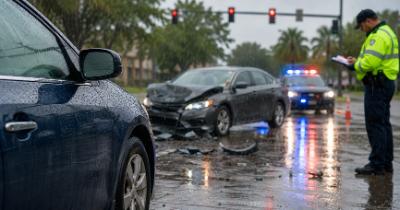
Florida law requires drivers to travel at a speed that is reasonable and prudent under existing conditions. A driver must reduce speed when weather or highway conditions create a special hazard. Driving below the posted limit can still be unsafe during a severe downpour, especially when visibility is limited or water is collecting on the road.
Florida Statutes section 316.183 addresses reasonable speed and weather-related hazards:
Florida law also requires a reasonable and prudent following distance based on traffic, speed, and roadway conditions. During heavy rain, you may need much more room to stop than you would need on dry pavement.
Florida Statutes section 316.0895 addresses following distance:
Headlights matter as well. Florida requires lighted lamps during rain, smoke, or fog. A driver who does not use headlights may be harder for other motorists to see, which can become part of a disputed fault analysis.
Florida Statutes section 316.217 addresses required vehicle lighting:
Rain changes the conditions, not the duty to drive with reasonable care. The posted speed limit may still be too fast for a severe storm.
Founding Attorney Attorney Attorney
Michael Serrano
Candace “Cea” Hartley

Molli Gard, ESQ.
Common Rain-Related Choices That Can Affect Fault
Investigators and insurance companies may review the choices made by every driver involved. Conduct that may support a negligence finding includes:
- Driving too fast for limited visibility or wet pavement
- Following another vehicle too closely
- Failing to use headlights during rain
- Making a sudden lane change or turn
- Entering standing water at an unsafe speed
- Using a phone instead of watching traffic
- Driving with badly worn or underinflated tires
- Failing to maintain windshield wipers, brakes, or lights
- Continuing to drive when visibility becomes dangerously poor
A driver does not need to receive a traffic citation for civil fault to be disputed. A police crash report may provide useful facts, but insurance companies, attorneys, and courts may also consider photographs, video, physical damage, vehicle data, and witness statements.
For a broader overview of Florida car accident claims, visit:
https://mikeserranolaw.com/2020/10/02/florida-car-accident-guide/
Does Hydroplaning Mean the Crash Was Unavoidable?
Not necessarily. Hydroplaning occurs when water reduces contact between the tires and the road. Steering and braking control may decrease quickly, but losing control does not automatically remove responsibility.
A fault investigation may examine:
- Vehicle speed
- Tire tread and pressure
- Visible standing water
- Surrounding traffic
- Braking and steering
- Lane position
- Headlight use
- Whether the driver had time to respond
Consider a driver traveling on I-275 during a heavy Tampa afternoon storm. Traffic begins slowing near standing water, but the driver maintains speed and follows closely. The vehicle hydroplanes during a lane change and strikes another car. Rain contributed to the loss of traction, but the driver’s speed, following distance, and lane movement may provide stronger evidence of fault.
A different result may be possible when water suddenly covers the road in a way that a careful driver could not reasonably anticipate. Each claim depends on the roadway, traffic, weather, vehicle condition, and driver conduct.
Mike Serrano’s law office was everything I needed after a very traumatic accident. He was always super up front and honest with me. I never got the feeling he was trying to sell me on something or to do something that I wasn’t comfortable with. He listened to my concerns and when it tough moments came that I needed to stand my ground. He backed me and made me feel 100% secure. He got me exactly what I needed in a settlement and I would never consider using anyone else. His office staff is also phenomenal.” - Mary Mike Serrano was a great attorney for my case!! He was very flexible with phone calls/ Zoom meetings. His staff are always friendly, whether it be on the phone or emails. They keep you updated during your entire case! They don’t leave you silent for months. if you call, they always call back with updates! Highly recommend!" - Kylie Collier Border I’ve never had to deal with a lawyer before but Mike has set the bar HIGH. He was always available to communicate my concerns and explain each step of the way. I know no other lawyer would have been able to achieve the same results because he jumped on an opportunity that was a little out of the ordinary and it paid off. He really fought for my case and over delivered. I really hope I never have another accident but if I do I’m running to Mike for help." - Sandy Carter
Can Both Drivers Be at Fault?
Yes. Florida follows a modified comparative fault system for many negligence claims. Your damages may be reduced according to your percentage of responsibility. In an ordinary negligence action, a party found more than 50 percent responsible for that party’s own harm generally may not recover damages.
Florida Statutes section 768.81 addresses comparative fault:
Suppose one driver is speeding in heavy rain and rear-ends another vehicle. The second driver had just entered the lane without enough space and did not have headlights on. The evidence may support assigning a percentage of fault to each driver.
Details matter. A statement such as, “I never saw the other vehicle,” may raise questions about visibility, headlights, speed, and attention. Saying, “I was driving the speed limit,” does not answer whether that speed was reasonable for the storm.
Choosing The Right Personal Injury Attorney Personal Injury Settlement TimelineRelated Videos
What Evidence Helps Prove Fault?
Rainy conditions can disappear before an adjuster or attorney sees the scene. Water drains, storms pass, traffic resumes, and damaged vehicles are moved. Evidence collected promptly may preserve details that will not exist later.
Useful evidence may include:
- Photographs of the road, standing water, lane markings, and vehicle positions
- Photographs of vehicle damage, tires, lights, and windshield wipers
- Video showing rainfall and visibility
- Dashcam or nearby surveillance footage
- Witness names and contact information
- The police crash report
- Vehicle event data and braking information
- Tire inspection and maintenance records
- Weather data for the time and location
- Medical, wage, towing, repair, and insurance records
One item rarely tells the entire story. Several sources that support one another can provide a clearer account of how the collision occurred.
What Should You Do After a Crash in Heavy Rain?
Your immediate safety comes first. Wet pavement, limited visibility, disabled vehicles, and approaching traffic can create another emergency.
When possible:
- Move away from active traffic if doing so is safe and lawful
- Call 911 and request medical help when needed
- Turn on hazard lights
- Exchange contact, vehicle, and insurance information
- Photograph the vehicles and road conditions from a safe position
- Identify witnesses and nearby cameras
- Seek medical evaluation for pain, dizziness, confusion, or numbness
- Keep medical bills, repair estimates, wage records, and insurance messages
- Avoid guessing about speed, distance, or fault
- Avoid posting detailed statements on social media
- Speak with an attorney before accepting a final settlement
More practical guidance is available here:
https://mikeserranolaw.com/2021/01/04/4-car-accident-tips/
How Insurance Companies May Use the Weather
An insurance company may argue that the storm caused the collision and that its insured driver could not prevent it. The company may also argue that you contributed to the crash by driving too fast, following too closely, failing to use headlights, or using worn tires.
Weather can support either side. Heavy rain may explain why you needed more time and distance to stop. It may also show why maintaining a normal dry-road speed was unreasonable.
A driver who says, “The rain made me lose control,” may only be describing the conditions. An insurance company may treat that sentence as an admission that the driver failed to maintain control. Provide accurate information, but do not guess about facts that you did not observe.
What Compensation May Be Available?
A rain-related Florida car accident claim may involve personal injury protection benefits, bodily injury liability coverage, uninsured or underinsured motorist coverage, health insurance, and property damage coverage.
Potential losses may include:
- Medical expenses
- Future care supported by evidence
- Lost income
- Reduced earning capacity
- Vehicle damage
- Pain and physical limitations
- Other accident-related losses permitted by law
The value of a claim depends on fault, medical evidence, insurance limits, causation, and the effect of the injuries.
Learn more about damages in a Florida car accident claim:
https://mikeserranolaw.com/2021/02/01/car-accident-case-damages/
How a Florida Car Accident Lawyer Can Help
A lawyer can investigate whether rain was simply part of the setting or whether unsafe conduct caused the crash. The work may include:
- Preserving video
- Inspecting vehicles and tires
- Reviewing weather and roadway information
- Locating witnesses
- Examining insurance policies
- Organizing medical records
- Responding to comparative fault allegations
- Identifying other responsible parties
Some cases may require review of a commercial driver, employer, vehicle owner, defective component, construction zone, or dangerous roadway condition. Claims involving a public agency may follow different procedures and deadlines.
Speak With a Florida Car Accident Lawyer About a Rain-Related Crash
A heavy-rain crash can leave you managing medical appointments, vehicle repairs, missed work, and conflicting accounts of fault. Serrano Law offers consultations and provides direct guidance to injured people in Hillsborough County, Tampa, Lutz, Wesley Chapel, and nearby Florida communities.
Call 813-553-5648 or visit:
https://mikeserranolaw.com/contact/
No outcome can be promised. Fault and compensation depend on the facts, evidence, insurance coverage, injuries, and applicable law.
This article is for informational purposes only and is not legal advice. Consult an attorney about your specific situation.
[/ux_html]