
Florida hurricane evacuation car accidents can involve heavy traffic, changing routes, poor visibility, standing water, disabled vehicles, and drivers who are trying to leave an area quickly. The Atlantic hurricane season runs from June 1 through November 30, and Florida emergency officials warn that large evacuations can cause major congestion and extended travel times. If you are driving in Hillsborough County, Tampa, Lutz, Wesley Chapel, or a nearby Florida community during an evacuation, you still have a duty to use reasonable care under the conditions.
If you are injured in a hurricane evacuation crash, focus first on your safety and medical needs. After the immediate emergency has passed, the questions may include who caused the crash, which insurance policies apply, what evidence still exists, whether Florida Personal Injury Protection applies, and which legal deadlines affect your claim.
Serrano Law represents people injured in Florida car accidents and can review the facts, insurance coverage, available evidence, and deadlines that may apply to your situation.
A hurricane can change the road conditions, but it does not automatically erase a driver’s responsibility to use reasonable care.






Why Hurricane Evacuation Car Accidents Can Be Different 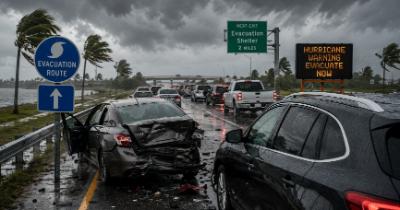
Hurricane evacuation car accidents are motor vehicle crashes, but evacuation conditions can make the facts harder to sort out. You may be driving in dense traffic with families, pets, luggage, emergency supplies, trailers, rental vehicles, or drivers who do not know the area. Traffic may remain slow for a long period and then move suddenly when a lane opens or a route changes.
Common hurricane evacuation crash patterns can include:
- Rear-end collisions in stop-and-go traffic
• Unsafe lane changes around congestion
• Multi-vehicle chain-reaction crashes
• Collisions involving vehicles stopped on shoulders
• Crashes involving reduced visibility or standing water
• Accidents involving trailers or heavily loaded vehicles
• Collisions with rental vehicles or out-of-state drivers
• Crashes near temporary road closures, detours, or changing traffic controls
Storm conditions can be part of the fault analysis, but the weather does not decide fault by itself. Florida law requires a driver to use a speed that is reasonable and prudent for the conditions and existing hazards. The law also requires an appropriately reduced speed when weather or highway conditions create a special hazard.
A driver may still be responsible for conduct such as following too closely, making an unsafe lane change, driving too fast for the conditions, failing to maintain control, or failing to react reasonably to traffic ahead.
For more information about Florida car accident liability, visit:
https://mikeserranolaw.com/liability-in-a-car-accident-case/
Founding Attorney Attorney Attorney
Michael Serrano

Candace “Cea” Hartley

Molli Gard, ESQ.
Does a Hurricane Evacuation Order Change Florida Negligence Law?
A hurricane evacuation order does not create a blanket exception to Florida negligence law. Drivers still need to act reasonably under the conditions they face. Depending on the circumstances, that can mean reducing speed, leaving more following distance, watching for emergency vehicles, obeying temporary traffic controls, and following lawful directions from law enforcement.
Florida uses a modified comparative fault rule in negligence actions covered by section 768.81. If you share responsibility for a crash, your damages can be reduced by your percentage of fault. A party found to be more than 50 percent at fault for his or her own harm generally cannot recover damages in a negligence action covered by that statute.
For example, traffic may be crawling during an evacuation when one driver changes lanes without enough room. A second driver may be following too closely and may be unable to stop. A third vehicle may then strike the second vehicle. The fault analysis can involve more than one driver.
Evidence that may help explain what happened can include:
- Photographs of vehicle positions and damage
• Witness statements
• Dashboard camera footage
• Traffic or business surveillance video
• Vehicle event data
• Phone or navigation records when legally obtainable
• Weather and roadway information
• Crash reports and diagrams
The goal is to identify which actions contributed to the collision rather than assuming that the storm caused everything.
Mike Serrano’s law office was everything I needed after a very traumatic accident. He was always super up front and honest with me. I never got the feeling he was trying to sell me on something or to do something that I wasn’t comfortable with. He listened to my concerns and when it tough moments came that I needed to stand my ground. He backed me and made me feel 100% secure. He got me exactly what I needed in a settlement and I would never consider using anyone else. His office staff is also phenomenal.” - Mary Mike Serrano was a great attorney for my case!! He was very flexible with phone calls/ Zoom meetings. His staff are always friendly, whether it be on the phone or emails. They keep you updated during your entire case! They don’t leave you silent for months. if you call, they always call back with updates! Highly recommend!" - Kylie Collier Border I’ve never had to deal with a lawyer before but Mike has set the bar HIGH. He was always available to communicate my concerns and explain each step of the way. I know no other lawyer would have been able to achieve the same results because he jumped on an opportunity that was a little out of the ordinary and it paid off. He really fought for my case and over delivered. I really hope I never have another accident but if I do I’m running to Mike for help." - Sandy Carter
What to Do After a Florida Hurricane Evacuation Car Accident
After a Florida hurricane evacuation car accident, your first priority is to get yourself and others away from immediate danger when you can do so safely. Call emergency services when anyone is injured, someone reports pain or discomfort, the crash blocks traffic, a vehicle cannot be driven safely, or the scene presents another serious hazard.
Florida law requires immediate notice to law enforcement for a crash involving injury or death or apparent damage of at least $2,000. Florida law also requires a law enforcement long-form crash report in several situations, including crashes involving personal injury, complaints of pain or discomfort, a vehicle that requires a wrecker because it is inoperable, or a commercial motor vehicle.
If conditions allow you to act safely:
- Move out of active traffic when appropriate and follow instructions from emergency personnel.
• Check yourself and your passengers for injuries.
• Exchange names, contact information, driver license information, vehicle details, and insurance information.
• Photograph the vehicles, damage, debris, standing water, lane markings, nearby signs, and visibility conditions.
• Get names and contact information from witnesses.
• Save dashboard camera footage before it is overwritten.
• Keep towing records, rental agreements, lodging records, evacuation alerts, navigation history, and relevant messages.
• Avoid guessing about speed, distance, weather effects, or fault.
• Notify the appropriate insurer promptly and give accurate basic information.
• Use care before giving a detailed recorded statement when fault or injuries are disputed.
For more information about steps after a collision, visit:
https://mikeserranolaw.com/2020/10/02/florida-car-accident-guide/
Medical Care and Florida PIP After an Evacuation Crash
Medical care and Florida PIP can become harder to manage after an evacuation crash because you may be staying in a hotel, shelter, another county, or a relative’s home. You may also be dealing with power outages, road closures, transportation problems, or limited access to your usual medical providers.
If you are injured, seek appropriate medical evaluation. Neck pain, headaches, dizziness, back pain, numbness, weakness, or other symptoms may become more noticeable after the initial stress of the crash.
Florida’s PIP law generally requires initial services and care within 14 days after a motor vehicle accident for medical benefits. The provider and type of care must also meet the requirements in the statute.
Keep copies of records connected to your treatment, including:
- Emergency room or urgent care discharge papers
• Medical records
• Prescriptions
• Bills and insurance explanations
• Referrals
• Work restrictions
• Mileage or travel records related to treatment
• Records showing where you were staying after the evacuation
Medical documentation can help establish what symptoms you reported, when you sought care, and which treatment followed the collision.
Choosing The Right Personal Injury Attorney Personal Injury Settlement TimelineRelated Videos
Which Insurance May Apply to a Hurricane Evacuation Crash?
Insurance after a hurricane evacuation crash may come from more than one source. Your own PIP coverage may provide qualifying benefits after the accident. Liability coverage may apply when another driver is legally responsible. Uninsured or underinsured motorist coverage may matter when the responsible driver has no applicable bodily injury liability coverage or not enough coverage for the losses involved.
Coverage questions can become more complicated when the crash involves:
- A rental vehicle
• A borrowed vehicle
• A rideshare driver
• A commercial vehicle
• A trailer
• An out-of-state driver
• A vehicle insured under a household or business policy
Do not assume that the first insurance policy you learn about is the only policy that may apply. Policy language, vehicle ownership, driver status, household relationships, employment, and signed coverage selections can affect the analysis.
For more information about crashes involving an uninsured driver, visit:
https://mikeserranolaw.com/other-driver-doesnt-have-insurance/
Why Evidence Can Disappear Faster During an Evacuation
Evidence during an evacuation can become difficult to recover because people, vehicles, and records may quickly move away from the crash location. A witness may continue driving to another county or another state. A rental vehicle may be returned in another city. A damaged car may be towed to a storage facility or salvage yard. Temporary traffic controls, water, debris, and roadway obstructions may be gone after conditions improve.
You can help preserve evidence by keeping original photographs and videos rather than only screenshots or edited copies. Note the names and locations of nearby businesses, homes, traffic cameras, or other possible video sources. Keep towing and storage documents. Preserve trip receipts, rental records, rideshare records, and evacuation alerts that may help establish the timeline.
If a commercial vehicle, rental vehicle, or rideshare vehicle was involved, records held by a company may also matter. A lawyer can evaluate whether a preservation request should be sent before relevant information is deleted or overwritten.
For more information about losses that may be part of a Florida car accident claim, visit:
https://mikeserranolaw.com/2021/02/01/car-accident-case-damages/
What Compensation May Be Available After a Florida Car Accident?
Compensation after a Florida car accident depends on the facts, injuries, available insurance, fault, medical evidence, and applicable law. A claim may involve economic losses and, when legal requirements are met, certain noneconomic losses.
Depending on the case, claimed losses may include:
- Medical expenses
• Future medical care supported by evidence
• Lost income
• Reduced earning capacity
• Vehicle or other property damage
• Pain and suffering when Florida law allows recovery
• Other legally recoverable losses supported by the evidence
A hurricane does not create a separate category of collision damages. The focus remains on documenting losses caused by the crash.
Keep records showing what you paid, which work you missed, how your vehicle was damaged, and how your injuries affected your daily activities. Documentation can help insurers, lawyers, and courts evaluate the claim based on evidence rather than estimates.
Florida Car Accident Deadlines Still Apply After a Hurricane
Florida car accident deadlines still apply after a hurricane. Under section 95.11, Florida generally provides a two-year limitations period for an action founded on negligence. The correct deadline can depend on the type of claim, the identity of the defendant, the date of the crash, insurance policy requirements, and other facts.
The two-year negligence period is not a universal deadline for every issue connected to a car accident. Insurance notice requirements, benefit requirements, claims involving governmental entities, and other legal matters can involve different time limits or procedures.
Evidence can also disappear long before a lawsuit deadline expires. Video may be overwritten, vehicles may be repaired or sold, and witnesses may become difficult to locate.
For more information about the broader Florida personal injury process, visit:
https://mikeserranolaw.com/2020/10/02/florida-personal-injury-guide/
How a Florida Car Accident Lawyer Can Help After an Evacuation Crash
A Florida car accident lawyer can help after an evacuation crash by separating storm conditions from the driving decisions and other conduct that may have caused the collision. The investigation may involve more than one driver, more than one insurance policy, and evidence located in different counties or states.
Depending on the case, a lawyer may help with:
- Obtaining available crash records
• Preserving video and electronic evidence
• Contacting witnesses
• Reviewing vehicle damage
• Identifying potentially responsible parties
• Reviewing PIP, liability, and uninsured or underinsured motorist coverage
• Examining medical records and bills
• Documenting lost income and other losses
• Evaluating comparative fault arguments
• Communicating with insurance companies
• Monitoring legal and insurance deadlines
• Filing a lawsuit when litigation is appropriate
Evacuation crashes can require coordination across county or state lines after drivers, witnesses, vehicles, and insurers leave the area. Organizing those records early can make the facts easier to evaluate.
Talk With a Florida Car Accident Lawyer After a Hurricane Evacuation Crash
If you or a loved one was injured in a hurricane evacuation crash in Hillsborough County, Tampa, Lutz, Wesley Chapel, or a nearby Florida community, Serrano Law can review the facts and explain the legal and insurance issues that may apply.
Call Serrano Law at (813) 553-5648 or visit:
https://mikeserranolaw.com/contact/
This article is for informational purposes only and is not legal advice. Consult an attorney about your specific situation.