
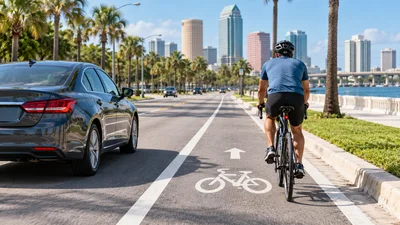
Florida bike lane accident liability usually depends on whether a driver, cyclist, or another party failed to use reasonable care and whether that conduct caused the crash. A marked bike lane can help show where a cyclist was traveling and what a driver should have anticipated, but the presence of a bike lane does not make fault automatic. Florida law gives bicyclists many of the rights and duties that apply to drivers, and a claim can turn on lane position, turning movements, traffic signals, visibility, speed, roadway conditions, and the conduct of everyone involved.
If you are a cyclist hit by a car in Florida, evidence from the scene can be central to determining responsibility. A driver may be liable for drifting into a bike lane, turning across a cyclist's path without yielding, entering from a driveway without checking for bicycle traffic, or failing to use reasonable care in another way. A cyclist can also share fault in some cases. Florida's modified comparative fault rule can reduce compensation based on a person's percentage of fault and can bar recovery in a covered negligence action when that person is found more than 50 percent at fault for his or her own harm.
For related information about bicycle accident claims, visit:
https://mikeserranolaw.com/hillsborough-county-bicycle-accident-lawyers/






When Is a Driver Liable for Hitting a Cyclist in a Bike Lane?
Bicycle accident liability usually starts with negligence. The main questions are whether the driver failed to act with reasonable care and whether that failure caused or contributed to the cyclist's injuries.
A bike lane collision may involve driver negligence when a driver:
- Drifts or merges into a marked bike lane without checking that the lane is clear.
- Turns right across a bike lane while a cyclist is proceeding straight.
- Turns left across the cyclist's path at an intersection.
- Pulls out of a parking lot, side street, or driveway without yielding.
- Drives while distracted and fails to see a cyclist who is visible.
- Passes a bicycle too closely when the cyclist and vehicle are occupying the same travel lane.
Florida Statutes section 316.2065 provides that a person riding a bicycle generally has the rights and duties that apply to the driver of another vehicle. The statute also requires a cyclist traveling below the normal speed of traffic to use an available bicycle lane, subject to exceptions. Those exceptions include preparing for a left turn, passing another bicycle or vehicle, and avoiding a condition or potential conflict that makes continued travel in the bike lane unsafe.
This means a cyclist may lawfully leave a bike lane when necessary to avoid hazards such as debris, parked vehicles, pedestrians, surface hazards, turn lanes, or other conflicts.
Key Point: A bike lane can be important evidence, but fault still depends on the conduct of the people involved and the facts surrounding the collision.
For a related discussion of bicycle and vehicle liability in Florida, visit:
https://mikeserranolaw.com/2026/06/04/bicycle-vs-vehicle-accidents-tampa-roads-liability-florida/

Michael Serrano
Founding Attorney

Molli Gard, ESQ.
Attorney
Why Right-Turn Bike Lane Collisions Can Lead to Liability Disputes
A bike lane conflict can occur when a motorist turns right across the path of a cyclist who is traveling straight. A cyclist may be proceeding through the lane while a driver approaches from behind and begins a turn into a driveway, parking lot, side street, or intersection.
Consider a cyclist traveling in a marked bike lane in Hillsborough County. A car approaches from behind and begins a right turn into a shopping center. If the driver crosses the bike lane without checking for the cyclist or without allowing the cyclist to proceed safely, the driver's turning movement may become central to a negligence claim.
Evidence can include the position of the bicycle and vehicle after impact, damage patterns, turn signals, nearby cameras, witness statements, lane markings, and the timing of traffic signals. A right-turn collision can become disputed when the driver and cyclist give different accounts of what happened.
Florida law also requires a motorist overtaking a bicycle in the same travel lane to pass at a safe distance of at least three feet. If the driver cannot safely provide that distance, the driver must remain behind until a safe pass can be made. This rule can become relevant when a cyclist leaves a bike lane because of debris, construction, a parked vehicle, or another hazard.

Mike Serrano’s law office was everything I needed after a very traumatic accident. He was always super up front and honest with me. I never got the feeling he was trying to sell me on something or to do something that I wasn’t comfortable with. He listened to my concerns and when it tough moments came that I needed to stand my ground. He backed me and made me feel 100% secure. He got me exactly what I needed in a settlement and I would never consider using anyone else. His office staff is also phenomenal.”
- Mary
Mike Serrano was a great attorney for my case!! He was very flexible with phone calls/ Zoom meetings. His staff are always friendly, whether it be on the phone or emails. They keep you updated during your entire case! They don’t leave you silent for months. if you call, they always call back with updates! Highly recommend!"
- Kylie Collier Border
I’ve never had to deal with a lawyer before but Mike has set the bar HIGH. He was always available to communicate my concerns and explain each step of the way. I know no other lawyer would have been able to achieve the same results because he jumped on an opportunity that was a little out of the ordinary and it paid off. He really fought for my case and over delivered. I really hope I never have another accident but if I do I’m running to Mike for help."
- Sandy Carter
Can a Cyclist Be Partly at Fault?
Yes. A cyclist can share responsibility when the cyclist's conduct contributes to a crash. Examples can include entering an intersection against a traffic signal, riding against the direction of traffic, making an abrupt movement that could not reasonably be anticipated, or riding at night without required lighting.
Shared fault does not always end a claim. Florida Statutes section 768.81 provides that damages can be reduced according to a party's percentage of fault. In a negligence action covered by that statute, a party found to be more than 50 percent at fault for his or her own harm may not recover damages.
The exact application of comparative fault depends on the facts and the type of claim. Evidence such as video, photographs, witness statements, road design, lighting, and vehicle damage can affect how responsibility is evaluated.
What Evidence Helps Establish Bicycle Accident Liability?
A Hillsborough County bicycle accident can depend on physical, digital, and witness evidence. Some evidence can disappear quickly, especially private surveillance footage or temporary roadway conditions.
Helpful evidence may include:
- Photographs of the bike lane, intersection, signs, roadway markings, and vehicle positions.
- Photographs of damage to the vehicle, bicycle, helmet, clothing, lights, and other gear.
- Dash camera, helmet camera, traffic camera, doorbell camera, or business surveillance footage.
- Witness names and contact information.
- The crash report and information about any citations issued.
- GPS or cycling application data when it reliably shows route, speed, or timing.
- Medical records documenting symptoms, diagnoses, and treatment after the crash.
- Records showing missed work, out-of-pocket expenses, and other financial losses.
The location and type of impact can also matter. A side impact involving a turning vehicle can suggest a different sequence of events from a rear impact or sideswipe. When the facts are disputed or the injuries are serious, attorneys may work with investigators or accident reconstruction professionals to evaluate the available evidence.
For more information about how liability can be evaluated in a bicycle and vehicle crash, visit:
https://mikeserranolaw.com/2026/06/04/bicycle-vs-vehicle-accidents-tampa-roads-liability-florida/
Related Videos
Choosing The Right Personal Injury Attorney
Personal Injury Settlement Timeline
Who Else Could Be Responsible for a Bike Lane Collision?
The driver is not always the only party that may have legal responsibility. A bicycle accident lawyer can investigate whether other people, businesses, insurers, or public entities may have played a role.
Potential issues can include:
- An employer's responsibility when a driver was working at the time of the crash.
- Vehicle ownership and any legal responsibility connected to the owner.
- A rideshare or commercial insurance policy when the driver was working through an app or operating a company vehicle.
- A dangerous roadway condition, obstructed sightline, or construction setup.
- A defective vehicle or bicycle component when a product issue contributed to the collision.
Claims involving government entities can involve different procedures, defenses, notice requirements, and deadlines. The police report may not identify every person or entity that should be investigated.
A careful investigation can help identify the parties, insurance policies, and evidence connected to the collision before important information is lost or documents are signed.
What Compensation May Be Available After a Florida Bicycle Accident?
Compensation depends on the facts of the crash, available insurance, the nature of the injuries, documented losses, and the degree of fault assigned to each party.
Potential damages can include:
- Past and future medical expenses.
- Lost income.
- Reduced earning capacity.
- Pain and suffering when recoverable under Florida law.
- Physical limitations and loss of normal activities.
- Scarring or disfigurement.
- Damage to the bicycle, electronics, clothing, helmet, and other property.
A serious bicycle collision can lead to orthopedic injuries, head injuries, road rash, nerve injuries, scarring, or long-term rehabilitation needs. The value of a claim depends on evidence of the losses and the effect of the injuries. It should not be based only on the first medical bill.
For broader information about Florida personal injury claims, visit:
https://mikeserranolaw.com/hillsborough-county-personal-injury-lawyers/
What Should You Do After a Bike Lane Crash?
Your health should come first. Call 911 when emergency assistance is needed and seek appropriate medical evaluation after the crash. Some injuries may not be fully apparent at the scene.
If your condition allows, consider taking these steps:
- Photograph the bike lane, intersection, signs, signals, road surface, nearby cameras, and vehicle positions.
- Photograph the bicycle, helmet, clothing, lights, and visible injuries.
- Get the driver's name, insurance information, and license plate number.
- Ask witnesses for their names and contact information.
- Preserve the bicycle and damaged equipment until they have been photographed and, when appropriate, inspected.
- Keep copies of medical records, bills, receipts, and documents showing missed work.
- Avoid guessing about speed, distance, visibility, or medical conditions when speaking with an insurance adjuster.
- Review documents carefully before signing a release or settlement agreement.
Florida currently provides a two-year limitations period for an action founded on negligence. The applicable deadline can vary based on the date the claim accrued, the parties involved, and the legal theory. Claims involving a state agency or other governmental entity can also involve separate statutory requirements. Waiting until a deadline is close can make it harder to preserve evidence and evaluate the claim.
How Can a Florida Bicycle Accident Lawyer Help?
A Florida bicycle accident lawyer can investigate how a vehicle entered or crossed the bike lane, preserve video and physical evidence, identify insurance coverage, evaluate comparative fault arguments, document damages, and communicate with insurers.
Legal counsel can also examine disputes about whether the cyclist left the bike lane, whether the driver checked mirrors or blind spots, whether the cyclist had required lighting, and whether road conditions contributed to the crash.
A lawyer may also investigate additional parties when the collision involves a commercial driver, employer, rideshare company, government entity, roadway defect, or another source of potential responsibility.
For information about Serrano Law's bicycle accident practice, visit:
https://mikeserranolaw.com/hillsborough-county-bicycle-accident-lawyers/
Speak With a Florida Bicycle Accident Lawyer About a Bike Lane Crash
If a driver hit you while you were riding in a bike lane in Hillsborough County or elsewhere in Florida, Serrano Law can review the circumstances and explain the legal options that may apply. The firm represents people in serious personal injury matters and serves clients throughout Florida.
Call Serrano Law at (813) 212-3771 to discuss your situation.
This article is for informational purposes only and is not legal advice. Every case depends on its own facts, applicable law, and available evidence. Consult an attorney about your specific situation.